How Much Is Each Question Worth on the SAT?
Get the short answer first, then see why a correct answer is one raw point but does not convert to a fixed number of scaled-score points.

Raw Points vs. Scaled SAT Scores
The word “point” can mean two different things when students talk about SAT scoring.
If you are asking how much a question is worth while checking an answer key, the practical answer is simple: one correct response adds one to your raw correct-answer count. A wrong answer and a blank answer do not add a raw point. That count is kept separately for Math and Reading and Writing.
The number printed on your score report is different. Each section is reported on a 200–800 scale, and the two section scores are added for a 400–1600 total. The conversion is not a classroom percentage where every question has a visible fixed price. It is a score conversion that accounts for the Digital SAT design and the difficulty of the questions you received.
That distinction explains why a calculator or chart can give a useful estimate without promising that every missed question costs exactly the same number of scaled points. Use raw points to review your practice test; use a score chart or calculator to estimate the reported score.
| Scoring layer | What a correct answer does | What it does not mean |
|---|---|---|
| Raw score | Adds 1 raw point within Math or Reading and Writing. | It is not automatically 10 points on the 200–800 scale. |
| Section score | Converts the section result to a 200–800 scaled score. | The same raw count is not a universal score on every form. |
| Total score | Adds Math and Reading and Writing section scores for 400–1600. | You cannot add raw correct answers directly to get a 1600-scale score. |
| Pretest item | Appears in the module but does not contribute to the reported score. | You cannot identify these questions by appearance or difficulty. |
Why One SAT Question Is Not Always 10 Points
The popular “10 points per question” shortcut mixes raw scoring with scaled scoring.
A 44-question Math section and a 54-question Reading and Writing section do not turn into scores by simply multiplying correct answers by a constant. The sections have different numbers of questions, and both sections are converted to the same 200–800 reporting scale. That alone makes a universal “points per question” rule impossible.
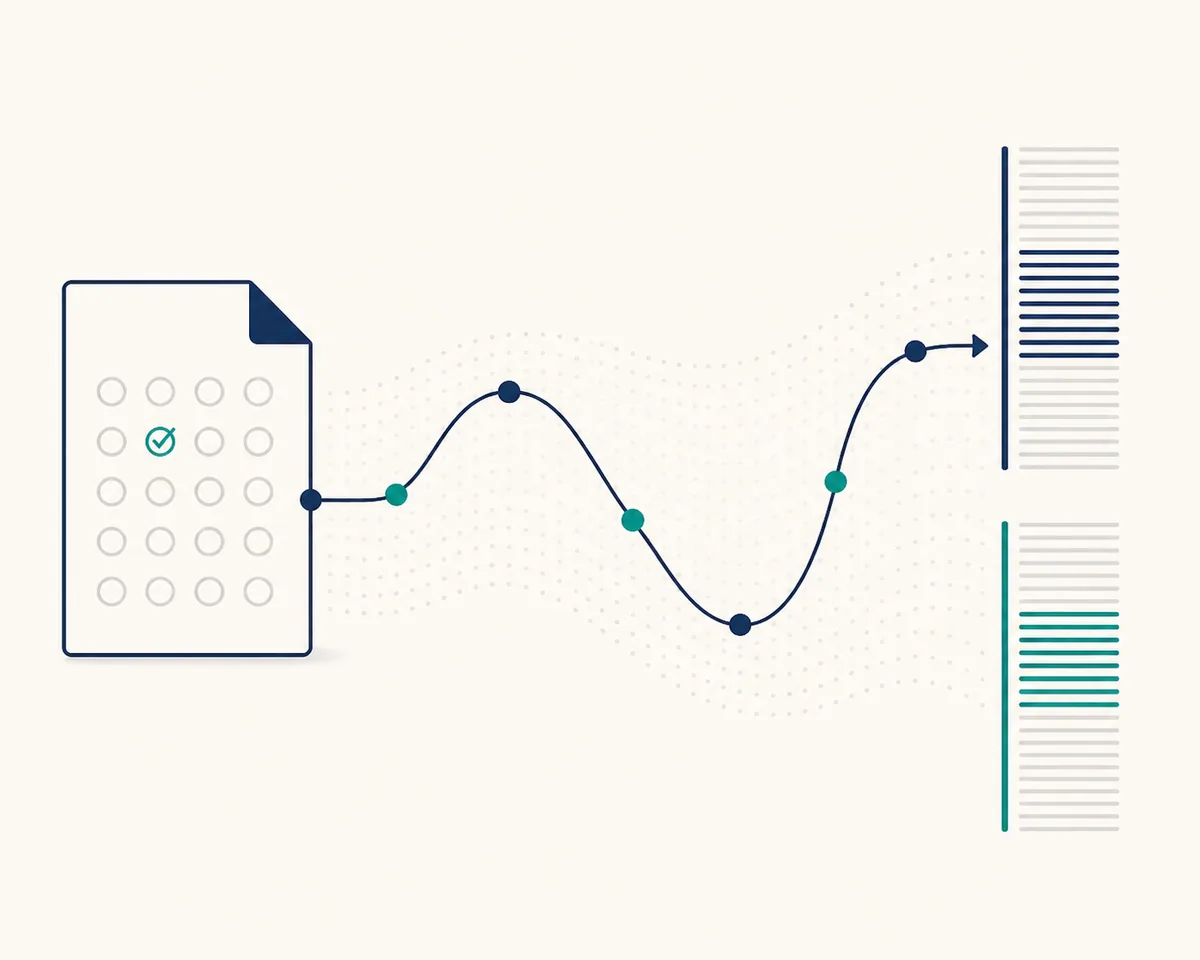
Digital SAT scoring adds another reason to avoid a fixed conversion. The test is multistage adaptive: your Module 1 performance helps determine the difficulty of Module 2. A raw result earned on a harder route can have a different scoring context from the same number correct earned on another route.
The safest wording is therefore: a correct answer is one raw point, but a question is not worth a guaranteed number of scaled points. If you see a table that says one missed question always equals a precise 10-, 20-, or 30-point drop, treat it as a rough example for one form, not an official rule.
Count correct answers as raw points. Do not promise a fixed scaled-score loss for one miss. The SAT score chart and SAT score calculator are better for practice estimates.
How Adaptive Modules and Equating Affect the Estimate
The Digital SAT uses a structured conversion rather than a single percentage formula.
Each section has two modules. Everyone answers the same number of questions in a section, but the difficulty mix of the second module depends on performance in the first. You cannot choose the route yourself, and you cannot return to a completed module.
After the test, College Board uses equating so scores from different forms can be compared fairly. Equating considers the characteristics and difficulty of the questions rather than creating a curve from the other students who tested that day. This is why a raw-to-scaled table is an estimate unless it is tied to the exact official form.
For study planning, this is not a reason to ignore raw counts. Raw counts show which section and question types need work. They are simply not enough to prove that one question is worth a fixed number of points on the final score report.
Math and Reading and Writing are separate
Keep the sections separate when reviewing a practice test. A total of 80 correct answers does not tell you the same story as 40 Math and 40 Reading and Writing, because the sections have different question counts and different scaled-score conversions.
Module 2 changes the scoring context
The number of questions does not change, but the route can change the difficulty mix and the range of scaled scores available. Do not compare two raw totals without noting the section and module path.
The score report is the final authority
A third-party calculator can estimate a practice result. Your official score report is the authoritative result for an actual SAT administration, and College Board's explanation of scoring is the right reference when a table conflicts with a report.
What About Unscored Pretest Questions?
Some questions are included for future test development rather than for your current score.
College Board explains that each Digital SAT module includes a small number of pretest questions. These questions are mixed into the module and are not identified to the student. Responses to them do not affect the score for that test, even though you should treat every question as if it counts.
This is another reason not to reverse-engineer a precise scaled value from a single practice result. You cannot know which questions are pretest items, and you cannot know the exact equating table for a future form. The best strategy is still to answer every question, review every mistake, and use score ranges for planning.
Examples: What One Question Means in Practice
These examples show what you can and cannot conclude from a raw correct-answer count.
| Practice-test situation | Certain raw result | What remains uncertain |
|---|---|---|
| 42 correct in Math | Math raw score = 42/44. | The exact 200–800 Math score depends on the form and route. |
| 50 correct in Reading and Writing | Reading and Writing raw score = 50/54. | There is no universal rule that converts the four misses to a fixed point loss. |
| 40 Math + 48 Reading and Writing | Combined raw correct answers = 88; keep the section counts separate. | You must convert both sections before adding them to a 400–1600 estimate. |
Notice the pattern: the raw number is exact, but the scaled result is a range or a form-specific conversion. That is why “I missed four questions” is not enough information to predict an official total. You also need to know which section, the module route, and the conversion table used for the test form.
For a quick estimate from raw correct answers, use the SAT score calculator. For a visual reference across raw-to-scaled outcomes, use the SAT score chart.
What to Do After a Practice Test
Turn the question into a study decision instead of chasing an imaginary fixed point value.
- Record Math and Reading and Writing correct answers separately. Do not combine the two raw counts into one percentage first.
- Review every missed or guessed question and label the reason: content gap, timing, careless error, vocabulary, or misunderstood prompt.
- Use an official practice-test conversion when one is provided for that form. Otherwise, use the SAT score calculator or score chart as an estimate, not a guarantee.
- Compare your section pattern with your goal. If Math is stable but Reading and Writing is falling behind, the next study block should not be chosen from the total score alone.
- Retest under the same module timing and record the new raw counts so your trend is comparable.
If you already have section scores and want to model a future target after more preparation, use the SAT Score Predictor. If your next question is about the calculator you may bring on test day, review the SAT calculator rules.
SAT Question Value FAQ
Short answers to the most common “how many points is one question?” questions.
Is every SAT question worth the same number of points?
For the raw score, each correct answer contributes one point within its section. For the reported scaled score, there is no universal fixed value per question because the conversion depends on the section, item characteristics, module route, and equating.
Is one SAT question worth 10 points?
No. Ten points can be a rough example from a particular table, but it is not an official rule for every Digital SAT form. Count one raw point for a correct answer and use a form-specific chart or calculator for a scaled estimate.
Do harder SAT questions count for more points?
They do not add more than one raw point when answered correctly. However, question characteristics and the adaptive Module 2 route affect how the raw performance is converted to a scaled section score.
How many points do I lose for one wrong answer?
There is no guaranteed scaled-score loss for one wrong answer. The effect can vary by section and test form, so use your official practice-test conversion or a range from the SAT score chart.
Can I calculate my SAT score from the number of questions I got right?
Yes, you can estimate a practice score by entering Math and Reading and Writing correct-answer counts separately. The result is useful for planning, but it may differ from an official score because adaptive scoring and equating are form-specific.
Should I leave a difficult SAT question blank?
No. There is no wrong-answer penalty, so enter your best answer on every question. Within the current module, use flags and return to hard questions if time remains; after moving to the next module, you cannot go back.
Remember the Two-Part Answer
Each correct Digital SAT answer is one raw point in its section. That is the clean rule to use while checking a practice test. The final SAT score, however, is a scaled Math score plus a scaled Reading and Writing score, not a direct multiplication of raw answers by a fixed number.
If a page claims that every question is always worth exactly 10 points, treat it as an oversimplification. Count your raw answers, note the section and module route, then use a score chart, calculator, or official practice-test conversion to estimate the range.
Official sources
- College Board — How SAT Scores Are Calculated — Official explanation of raw scores, adaptive modules, question characteristics, and equating.
- College Board — How the SAT Is Structured — Official section, module, question-count, and timing information.
- College Board — SAT Calculator Policy — Official calculator policy for the Math section.