SAT Practice Test 7 Scoring: Raw Score to Range Guide
Count answers by section, read the official Practice Test 7 conversion ranges, and understand why a paper score range is different from a Bluebook adaptive result.
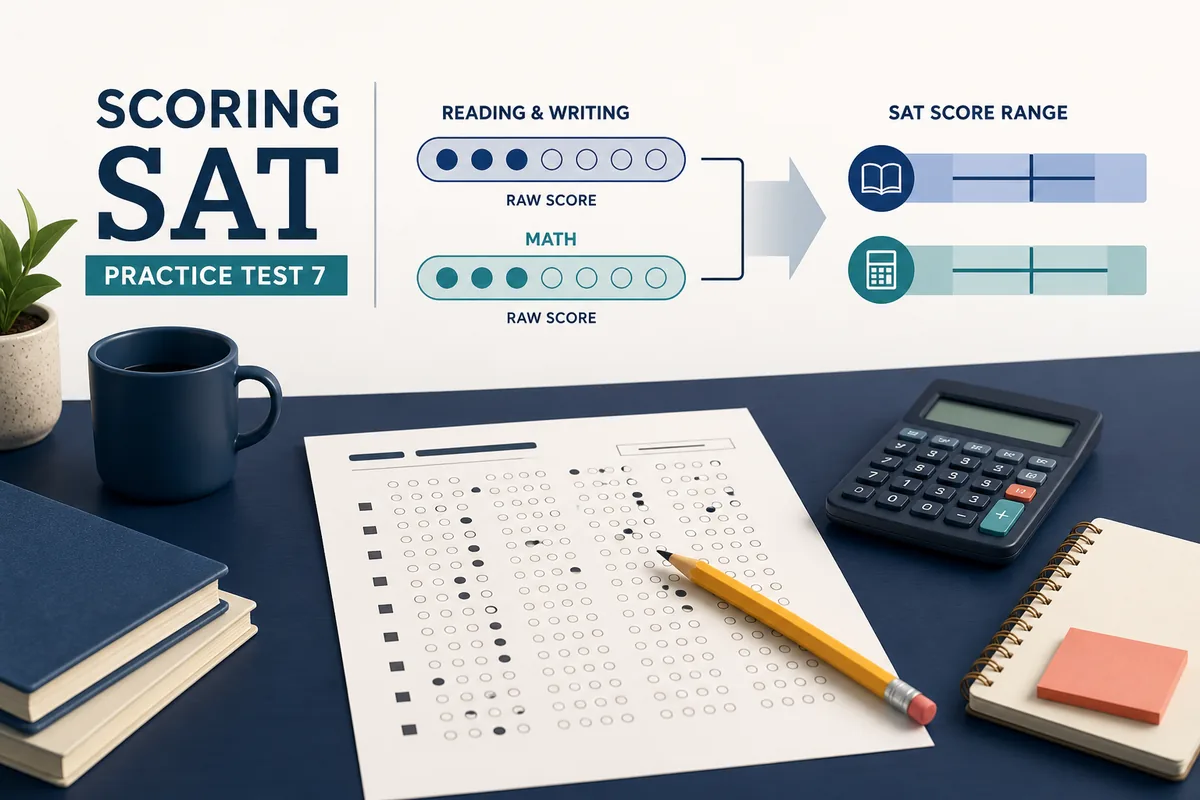
What the Official Practice Test 7 Scoring Guide Does
Use the guide to produce a defensible score range, not a false-precision single number.
College Board's Practice Test 7 scoring document is designed for students who completed the paper version of that digital SAT practice test. It pairs an answer key with section-specific conversion ranges, so you can review the test without pretending that a simple percentage reproduces the adaptive Digital SAT scoring model.
The paper guide keeps the two SAT sections separate. Reading and Writing uses a 0–66 raw-score scale, while Math uses a 0–54 raw-score scale. Those limits belong to this Practice Test 7 worksheet. Do not replace them with a different question count from another practice form or with a combined total of all correct answers.
Each section maps to a 200–800 score range. Your total range is built only after both section ranges are found: add the two lower endpoints for the bottom of the total and add the two upper endpoints for the top. That makes the output useful for planning while keeping the uncertainty visible.
This distinction matters when people search for SAT Practice Test 7 scoring. A raw score is not the same as a scaled score, and a paper conversion range is not a guarantee of what Bluebook will report for a separate adaptive practice attempt.
Do not add Reading and Writing and Math correct answers before conversion. Count each section, convert each section, and only then add the lower values together and the upper values together.
How to Calculate Your SAT Practice Test 7 Raw Score
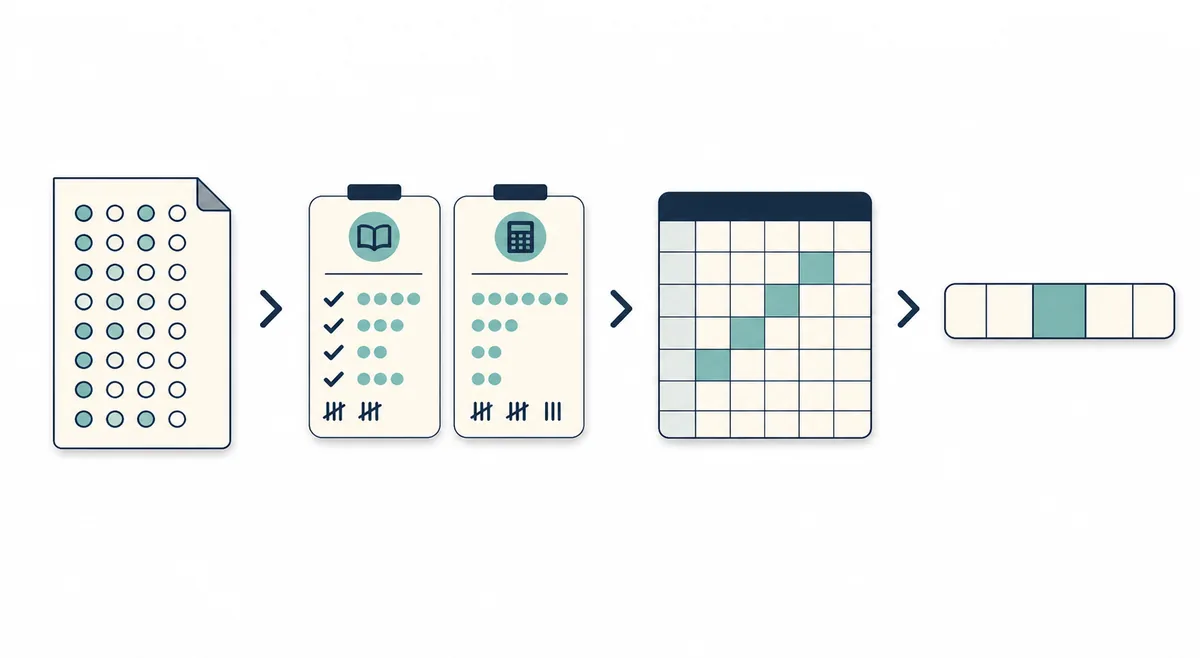
Keep two section totals from the answer key before opening the conversion table.
- 1. Check the answer key. Compare every response with the official Practice Test 7 answer key. Count a response as correct only when it matches the key; do not treat an unanswered question as correct.
- 2. Count Reading and Writing. Add correct answers from the Reading and Writing modules. For the Practice Test 7 paper worksheet, record a raw score from 0 to 66.
- 3. Count Math. Add correct answers from the Math modules. For the Practice Test 7 paper worksheet, record a raw score from 0 to 54.
- 4. Read both section ranges. Find the Reading and Writing row and the Math row that match your raw scores in the official Practice Test 7 table. Write down the lower and upper endpoint for each section.
- 5. Add the endpoints. For the total lower bound, add Reading and Writing lower + Math lower. For the total upper bound, add Reading and Writing upper + Math upper.
The point of the worksheet is diagnostic clarity. Keep the section totals and missed-question notes beside the final range so you can tell whether a change came from content knowledge, timing, careless errors, or a different scoring source.
Practice Test 7 Raw-to-Scaled Score Examples
These selected examples follow the official Practice Test 7 paper conversion table; total examples are derived by adding section endpoints.
| Section or total | Raw score | Score range | How to use it |
|---|---|---|---|
| Reading and Writing | 40 / 66 | 480–540 | Use as the section estimate |
| Math | 40 / 54 | 560–640 | Use as the section estimate |
| Total example | 40 RW + 40 Math | 1,040–1,180 | Add both section ranges |
| Reading and Writing | 50 / 66 | 590–650 | Use as the section estimate |
| Math | 44 / 54 | 630–690 | Use as the section estimate |
| Total example | 50 RW + 44 Math | 1,220–1,340 | Add both section ranges |
These are selected rows, not the complete conversion table. The official PDF is the source for every Practice Test 7 row and its paper-version instructions. Keep the section label attached to every raw score because the same number correct does not map to the same range in Reading and Writing and Math.
Paper Scoring Guide vs Bluebook Adaptive Scoring
Use the scoring source that matches how you took Practice Test 7.

| Practice format | What you see | Best scoring source | Use the result for |
|---|---|---|---|
| Paper version of Practice Test 7 | Printed questions and answer key | Official Practice Test 7 range table | A test-specific range and error review |
| Bluebook digital practice | Computer-based adaptive modules | Bluebook score report | The closest estimate for that digital form |
| Third-party or mixed practice | Different form, source, or answer key | The provider's own method | Trend tracking, not an official SAT score |
The Practice Test 7 PDF is useful because it shows the answer-checking workflow and a transparent range table for one paper form. It is not a replacement for the score report from an adaptive Bluebook practice test. When the practice format changes, the scoring source changes with it.
If you completed Practice Test 7 in Bluebook, begin with the score shown by Bluebook. If you used the printable version and answer key, use the official Practice Test 7 table. If you are comparing unofficial practice forms, record the provider and conversion method next to each result so a table difference is not mistaken for a real performance change.
How to Review Your Practice Test 7 Result
The score range is the starting point; the error review tells you what to do next.
Separate knowledge errors from timing errors.
A missed algebra question because you forgot a rule needs a different fix from an arithmetic slip or a question you never reached. Tag each miss before starting another full test.
Keep Reading and Writing and Math separate.
A combined percentage can hide the section that is limiting your total. Compare each raw count with its range and use the section result to choose the next study block.
Treat the range as a planning interval.
Do not record only the midpoint. Track the lower and upper endpoints across comparable practice forms, then set a target around the pattern rather than one unusually high or low result.
Choose the right next resource.
Use the SAT score predictor for a broader planning estimate, the SAT score chart for a quick reference, the SAT Math score calculator when you only know Math, or the Practice Test 8 scoring guide when reviewing that form.
SAT Practice Test 7 Scoring FAQ
Short answers to the questions students usually ask after checking the answer key.
How do I score SAT Practice Test 7?
Count correct answers separately for Reading and Writing and Math, use the official Practice Test 7 conversion table for each raw score, then add the lower endpoints and upper endpoints to get a total range.
Is the Practice Test 7 scoring table an exact Digital SAT conversion?
No. It is a simplified, test-specific range guide for the paper version of the practice test. If you completed the adaptive Bluebook version, use the Bluebook score report for that attempt.
What is a 40 raw score on SAT Practice Test 7?
In the selected official rows, a Reading and Writing raw score of 40 maps to 480–540, while a Math raw score of 40 maps to 560–640. The section label matters because raw score 40 does not mean the same range in both sections.
How do I calculate the total Practice Test 7 range?
Convert the two section raw scores separately. Add Reading and Writing's lower endpoint to Math's lower endpoint for the bottom, then add the two upper endpoints for the top.
Why can a calculator estimate differ from the official Practice Test 7 range?
A calculator is an estimate based on a model, while the official guide uses the conversion table for one practice form. The two outputs should not be treated as interchangeable.
Can I use the Practice Test 7 table for another SAT practice test?
Do not assume that you can. Use the matching official guide when a form-specific table exists, or use the score report from the digital platform that delivered the test.
Use Practice Test 7 as a Diagnostic, Not a Promise
The safest way to read SAT Practice Test 7 scoring is to preserve the two-part process: section raw scores first, then the official range table. That keeps the result honest and makes it easier to see whether Reading and Writing or Math needs the next round of work.
When you plan the next study block, combine the official range with your error log. Use the calculator or predictor for a quick estimate, but keep the official College Board source matched to the format you actually used: the paper guide for the printable test and Bluebook for an adaptive digital attempt.
Official sources
- College Board — Scoring Your Paper SAT Practice Test 7 — Answer-key workflow, section conversion ranges, and the paper-version limitation.
- College Board — SAT practice tests — Official practice-test formats and Bluebook practice context.
- College Board — How SAT scores are calculated — Official scoring context for why raw answers are not a universal shortcut.
- College Board — SAT test structure — Current section, module, question-count, and timing context.