How Many Questions Are on the SAT? Digital SAT Format Explained
A practical breakdown of all 98 Digital SAT questions, the four adaptive modules, section timing, pacing checkpoints, and what the question count means for your score plan.
How Many Questions Are on the Digital SAT?
The official 2026 structure contains 98 questions across two sections and four modules.
The current Digital SAT is shorter than the old paper SAT, but it still tests a broad set of reading, writing, algebra, advanced math, data analysis, geometry, and trigonometry skills. The test begins with Reading and Writing, pauses for a 10-minute break, and finishes with Math.
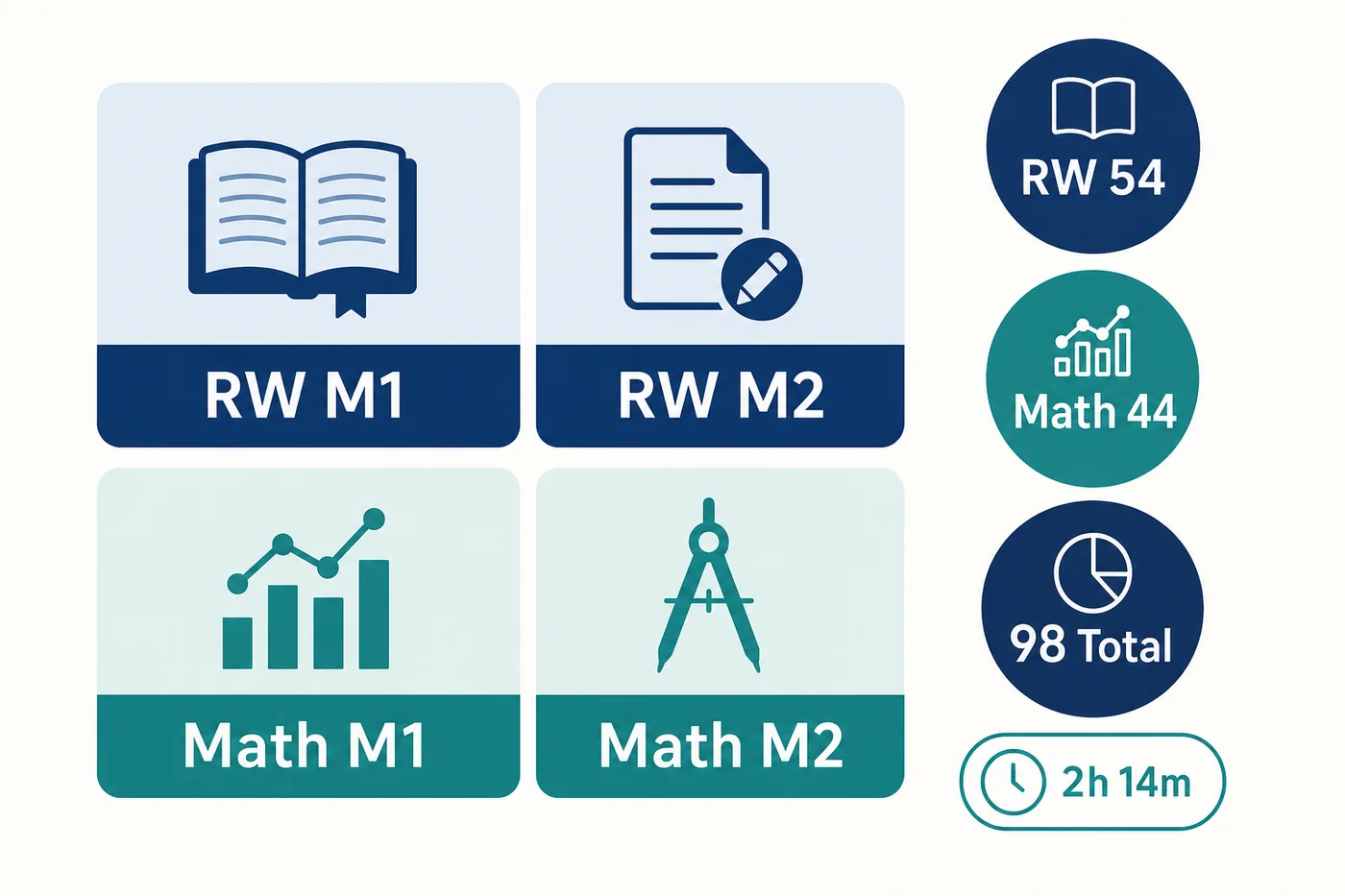
College Board lists 54 Reading and Writing questions and 44 Math questions. Because each section is divided into two equal-length modules, the practical module count is 27 Reading and Writing questions per module and 22 Math questions per module. You should plan around the full count even though the testing system may include questions used for research or future test development; the interface does not tell you which questions those are.
| Section | Questions | Modules | Section time | Average pace |
|---|---|---|---|---|
| Reading and Writing | 54 | 2 × 27 | 64 minutes | About 71 seconds each |
| Math | 44 | 2 × 22 | 70 minutes | About 95 seconds each |
| Total | 98 | 4 | 2 hours 14 minutes | Varies by section |
Timing above covers the two scored sections. Add the scheduled 10-minute break when estimating your total time at the test center.
How the SAT's Four Adaptive Modules Work
The question count is fixed, but the difficulty path changes after each section's first module.
The Digital SAT is multistage adaptive. In Reading and Writing, you complete Module 1 before moving to Module 2. Math follows the same pattern after the break. Your performance in a section's first module helps determine whether the second module is generally more difficult or less difficult.
That routing decision does not add or remove questions. Every student still receives two Reading and Writing modules and two Math modules with the same section totals. What changes is the mix and difficulty of the questions, which is one reason a simple percentage-correct formula cannot reproduce an official SAT score exactly.
Reading and Writing: 27 questions per module
The 54 Reading and Writing questions are split evenly into two 32-minute modules. Questions combine a short passage or pair of passages with one task. The section covers Information and Ideas, Craft and Structure, Expression of Ideas, and Standard English Conventions.
Math: 22 questions per module
The 44 Math questions are split evenly into two 35-minute modules. Most are multiple choice, while some require you to enter your own answer. The embedded Desmos calculator is available throughout Math, and you may also bring an approved handheld calculator.
You cannot return to an earlier module
Within a module, you can move among questions and review flagged answers. After time expires or you advance to the next module, you cannot reopen the previous module. That makes end-of-module review time more valuable than saving all review for the end of the test.
How Much Time Do You Get per SAT Question?
Use section-specific pacing rather than one average for all 98 questions.
Reading and Writing gives you about 71 seconds per question on average. Math gives you about 95 seconds per question. Those are planning averages, not strict limits: a vocabulary-in-context item may take less than a minute, while a multistep Math problem may reasonably take longer.
A better pacing system checks your progress near the midpoint and reserves a small review buffer. The Bluebook clock shows your remaining time, and you can hide or reveal it, but practicing with the same checkpoints makes test-day decisions easier.
| Checkpoint | Reading and Writing module | Math module |
|---|---|---|
| Start | 27 questions / 32 minutes | 22 questions / 35 minutes |
| Halfway | Around question 14 with 16 minutes left | Around question 11 with 17–18 minutes left |
| Review buffer | Aim for 2–3 minutes | Aim for 3–5 minutes |
A practical three-pass strategy
- Answer straightforward questions first, but do not rush solely because the total is 98. Accuracy matters more than finishing unusually early.
- If a question is consuming too much time, choose your best answer, flag it, and continue. There is no penalty for a wrong answer, so never leave a question blank intentionally.
- Use the final minutes of each module for flagged questions, input mistakes, and unanswered items. You cannot transfer unused time from one module to another.
How Does the Number of Questions Affect Your SAT Score?
Your score is not calculated as a simple 98-question percentage.
The SAT reports a 400–1600 total score. Reading and Writing contributes 200–800 points, and Math contributes 200–800 points. College Board uses equating and the adaptive route to convert performance into scaled section scores, so two students with the same number correct can receive slightly different estimates depending on the questions and module path they encountered.
For that reason, statements such as “one question always equals 10 points” are not reliable. Near the top of the scale, one missed question can matter noticeably on some test forms; elsewhere, several raw-score outcomes may map to nearby scaled scores. Use question-count estimates as a study-planning tool, not as an official score guarantee.
If you already know how many questions you answered correctly, use the SAT score calculator. If you want a quick reference for possible raw-to-scaled outcomes, compare the SAT score chart. For a focused explanation of whether one question has a fixed scaled value, read how much each SAT question is worth.
“How many questions are on the SAT?” has one fixed answer for the current format: 98. “How many can I miss for a 1400 or 1500?” does not have one fixed answer because Digital SAT equating and adaptive routing vary.
SAT vs. PSAT Question Counts
Do not use the SAT's 98-question total when planning for a PSAT assessment.
| Test | Total questions | Testing time | Score range |
|---|---|---|---|
| SAT | 98 | 2 hr 14 min | 400–1600 |
| PSAT/NMSQT and PSAT 10 | 98 | 2 hr 14 min | 320–1520 |
| PSAT 8/9 | 98 | 2 hr 14 min | 240–1440 |
The digital SAT Suite assessments share a similar two-section, four-module experience, but their score ranges and question difficulty targets differ. Read the PSAT vs SAT comparison for the purpose, difficulty, and scoring differences. Use the PSAT score calculator for PSAT/NMSQT or PSAT 10 estimates, and the PSAT 8/9 score calculator for the earlier assessment.
SAT Question Count FAQ
Short answers to common questions about the Digital SAT format.
How many questions are on the SAT in 2026?
There are 98 questions on the current Digital SAT: 54 Reading and Writing questions and 44 Math questions.
How many Math questions are on the SAT?
The SAT Math section has 44 questions split into two 22-question modules. You receive 35 minutes for each module, or 70 minutes total.
How many Reading and Writing questions are on the SAT?
Reading and Writing has 54 questions split into two 27-question modules. Each module lasts 32 minutes, for 64 minutes total.
How long is the SAT with breaks?
The two timed sections total 2 hours 14 minutes. With the scheduled 10-minute break between sections, the planned testing block is about 2 hours 24 minutes, not including check-in, instructions, or administrative delays.
Do you get a calculator on the SAT?
Yes. Bluebook includes the Desmos graphing calculator for the entire Math section. You may also bring an approved handheld calculator. Review the SAT calculator rules before test day.
Can you skip questions on the Digital SAT?
You can move around within the current module and return to flagged questions before the module ends. You cannot return after moving to the next module. Because there is no wrong-answer penalty, enter your best answer for every question.
How many questions can you miss and still get a 1500?
There is no guaranteed number because scoring varies by test form and adaptive route. A rough high-score estimate often allows only a small number of misses across both sections, but use the score chart and your official practice-test conversion for a more realistic range.
Plan for 98 Questions, One Module at a Time
The answer is straightforward: the Digital SAT has 98 questions. The useful planning detail is how those questions are distributed—27 Reading and Writing questions in each of two modules, then 22 Math questions in each of two modules.
Practice with the actual module clocks, protect a short review buffer, and judge performance by section rather than by one overall percentage. When you finish a practice test, convert your correct-answer counts into a realistic score range instead of assuming every missed question has the same point value. For the official paper worksheet for SAT Practice Test 6, use the dedicated Practice Test 6 scoring guide rather than a generic conversion.
Official sources
- College Board — How the SAT Is Structured — Official section question counts, timing, modules, and break structure.
- College Board — The Reading and Writing Section — Official Reading and Writing content domains and format.
- College Board — The Math Section — Official Math content and response format.
- College Board — SAT Calculator Policy — Official embedded and handheld calculator rules.